
Community and Indigenous Policing Unit – West Shore RCMP
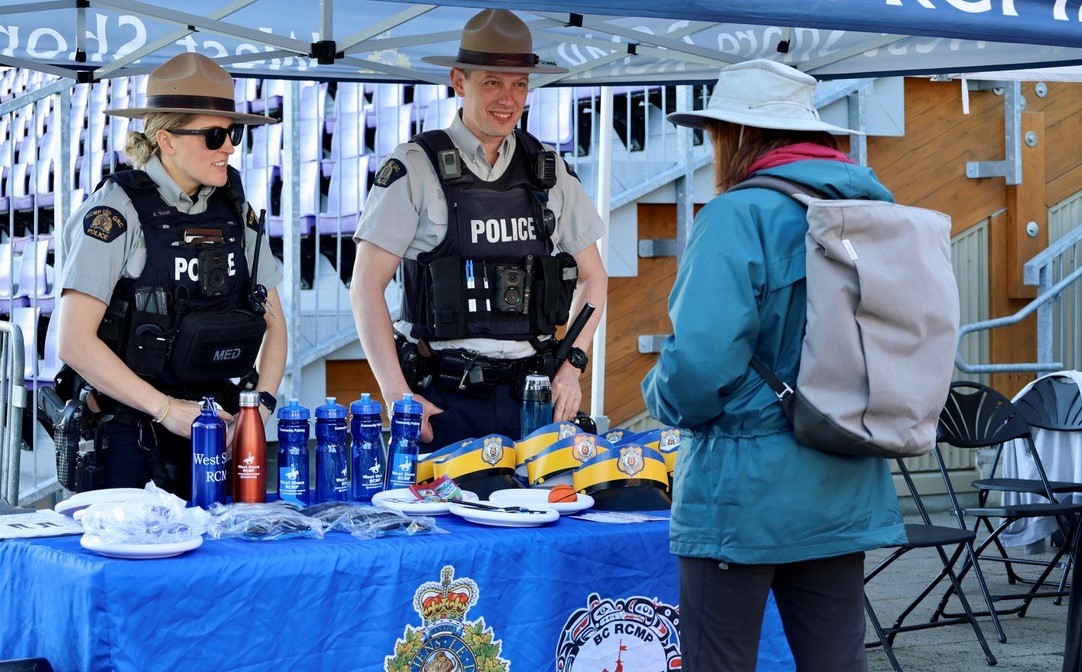
RCMP officers at community event
The West Shore RCMP Community and Indigenous Policing Unit (CIPU) focuses on community outreach, relationship building, and crime prevention across the West Shore. CIPU works closely with community partners and stakeholders to develop and deliver targeted education and prevention initiatives that address local areas of concern. Officers actively engage with the community through school programs, presentations, and participation in community events. On average the unit attends over 200 community events a year.
The West Shore RCMP Community and Indigenous Policing Unit look after the following:
- Public and personal safety talks;
- Community engagement events;
- School Liaison Officers;
- Speed Watch.
Interested in volunteering?
To request a volunteer application, please;
- visit the detachment or
- submit an email request. (Do not change the subject line, a volunteer application will be emailed to you.)
Completed forms can be emailed to cole.brewer@rcmp-grc.gc.ca or dropped off to:
West Shore RCMP Detachment
698 Atkins Ave.
Victoria, B.C. V9B 3A4
If you have any questions or require further information please contact the West Shore RCMP Community Policing Section at 250-391-3367
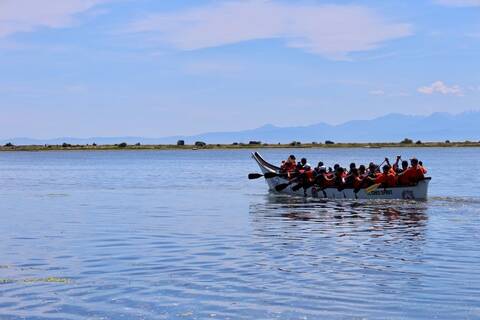
People rowing in the West Shore RCMP TL’Ches Spirit canoe
Indigenous Community Policing - West Shore RCMP
Two constables within the Community and Indigenous Policing Unit serve as a dedicated Indigenous Police Officers, working directly with the Songhees Nation and Esquimalt Nation to support ongoing relationship building and community engagement. This role focuses on collaboration, trust, and meaningful partnership with the Nations.
West Shore RCMP TL’Ches Spirit Canoe Program
Video:
Transcript - West Shore RCMP - West Shore RCMP TL’Ches Spirit Canoe Program
Video Description and close captioning –
Various shots of West Shore RCMP and community members paddling throughout the West Shore area on the canoe “TL’Ches Spirit”. Cst. Cole Brewer narrating in the background explaining what the program is about.
Video Transcript – Cst. Cole Brewer
My name is Constable Cole Brewer. I work in the Indigenous Policing Unit here at West Shore and serving Songhees and Esquimalt First Nations.
Providing a police service to a west coast Indigenous community. One of the ways, we’re always looking for ways to engage with youth, is utilizing the canoe to engage with youth. Our canoeing program, seemed like the perfect fit because it is really is in the blood of our youth. It doesn’t matter the weather conditions or anything like that, they are always motivated to paddle. And so getting the canoe and using it to engage with youth, at first we engaged mostly with Indigenous youth in the community. But now it’s branched out to engaging with all youth in the spirit of reconciliation.
As police, our job is so many things. It’s not just enforcement capacity. We’re also, we have to be able to connect with the community. You know, when you take away the uniform that makes it really clear when we’re out in the canoe and we’re sharing other skills and other information. And doing things in a fun manner really helps break down those barriers.
We worked really closely with some elders in the community. Specifically, one of the key elders would be Elder Joan Morris from Songhees, traditional name “Sellemah”. Elder Sellemah worked with us all the way through this. If you stand on Willows Beach and look out, you will see a series of Islands. Little Chatham, Big Chatham, and Discovery Island. Those islands are part of the Songhees reserve. And “TL’Ches” in Lekwungen means ‘island’. But it specifically refers to the former Songhees village site on Big Chatham Island. Elder Sellemah is the last Songhees member to have been born on the island.
We ensure that every time the canoe goes out, we usually share and call Elder Sellemah. Tell her where we’ve gone out, who we’ve been with. Because of the connect with the canoe and the project to the community, we also have a cultural responsibility to pass on to anybody who goes out on the canoe. And it’s just as important as the safety briefing that we give. It’s the cultural briefing. As Skippers, we’re responsible for making sure that everybody understands the name of the canoe “TL’Ches Spirit”.
The artwork on the canoe, includes the wolf on the front of the canoe. Which in Lekwungen is a “stqéyə” (Sta-Kay-Yah)”. We had the wolf out on the islands a few years ago. And a lot of community members believed that is part of the spirit of the late Chief Robert Sam. And so that is why we have a stqéyə on the canoe.
Athletics, sports, culture, being outside. When we have youth on the canoe the other thing they really have to worry about is the paddle in their hand and looking forward and staying in in sync. And it’s a really calming. You’re at peace with nature and also there’s the cultural connection to being out on the water. Which is really evident, especially when we have our Indigenous youth out there.
For us to be, to share in that, and be part of that with our community is one thing. And also when we’re engaging with the schools, sharing those teachings with and those skills with other students, it’s really empowering. And it’s a lot of fun.
It’s important that we patch on those cultural teachings. Because it connects everybody who goes on the canoe to the community and the culture of the community. Both past, present, and futures.
Canoe Training Video:
Transcript - West Shore RCMP - West Shore RCMP TL’Ches Spirit Canoe Program
[Cpl. Brewer standing by the West Shore RCMP TL’Ches Spirit Canoe Program talking about the program.]
Cpl. Brewer: We have four skippers here at West Shore and we’re all certified by Transport Canada as ‘Paddle Canada Big Canoe Leader’.
[Wide angle sot of the canoe on the waters shore. Canoe is empty.]
Cpl. Brewer: Which really is the safety aspect of every time we go out, we’re in charge. Our canoe is a commercial vessel,
[Close up of the Canoe logo. Scene of the canoe filled with paddlers, paddling on the water.]
Cpl. Brewer: And so we have to give, as if you were to go on a plane or a BC ferry, we have to give a safety precaution, safety instructions for what we do.
[Scene of Cpl. Brewer and another RCMP officer talking to a group of people with the canoe in the back ground.]
Cpl. Brewer: As well, there’s just instruction, general paddling instruction.
[Scene of officer showing paddles how to handle the paddles and safety equipment.]
Cpl. Brewer: So the West Shore, Victoria, we’re on an island.
[Scene of the TL’Ches Spirit Canoe pushing off and canoeing in the water.]
Cpl. Brewer: We’re surrounded by water and I think sometimes we take some of that for granted. And water safety is a huge thing. That’s one of the things we always stress. We also have to have the proper safety equipment.
[Scene of a West Shore RCMP vehicle towing the canoe.]
Cpl. Brewer: So we make sure everyone, regardless of their capacity and ability to swim or things like that, everybody has to wear a PFD.
[Scene of life jackets displayed on the ground.]
Cpl. Brewer: As well too, even a lot of things we also touch on is cold water safety because most drownings occur within 15 feet of shore.
[Scene of the TL’Ches Spirit Canoe in the water.]
[Scene of Cpl. Brewer speaking while standing next to the canoe.]
Cpl. Brewer: And so people have to be aware of that. And that’s usually another piece that we usually touch on as well.
[Scene of the TL’Ches Spirit Canoe in the water.]
[RCMP logo and End credits.]
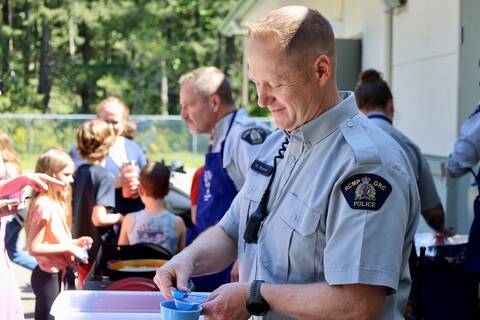
RCMP officer preparing Bannock at a community engagement event
School Liaison Officers
School Liaison Officers within the Community and Indigenous Policing Unit maintain active connections with more than 30 schools across the West Shore, including elementary, middle, and secondary schools, as well as private schools and post-secondary institutions.
On average School Liaison Officers complete over 400 school visits per school year. In addition to school visits they conduct proactive patrols in areas frequented by youth during lunch hours and after school. By being a consistent presence within school communities and fostering familiar, positive relationships outside of an enforcement context, officers help create an environment of trust and approachability. These connections have proven critical, as they help ensure youth who are experiencing victimization feel safe and supported when coming forward to police.
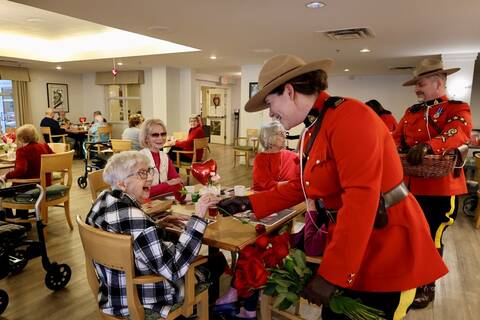
RCMP officer handing out roses during a Valentines day community event at a local seniors home
West Shore Youth Outreach Team
School Liaison Officers are also part of the West Shore Youth Outreach Team, working in partnership with a youth counsellor from the Pacific Centre Family Services Association. Established in 2021, the West Shore Youth Outreach Team provides coordinated, proactive, and West Shore Youth Outreach Team referral-based support to at-risk youth, with a focus on mentoring and prevention. The team prioritizes confidentiality between the youth counsellor and youth receiving services, ensuring appropriate support and referrals while maintaining trust, and meaningful engagement through this program has resulted in positive feedback from families across the West Shore.
See our video:
Transcript - West Shore Youth Outreach Team brings support and resources to youth in the West Shore
[West Shore Youth Outreach Team]
[Video begins with text that reads: The role of the counsellor is to support and advocate for youth. West Shore Youth Outreach team understands that confidentiality between the Youth Counsellor and the Youth receiving support is of paramount importance. The team ensures that the Youth Counsellor provides support and resource for the youth while maintaining their confidentiality. The youth and family counsellors also see’s youth for a variety of other concerns.]
Cpl. Cole Brewer – Supervisor, West Shore RCMP Community and Indigenous Policing: The western communities is one of the fastest growing communities on Vancouver Island, in the province, and in the country. We have the two largest high schools on Vancouver Island right here in West Shore with Belmont and Royal Bay. So, it’s diverse, we have a lot of students. It’s only going to grow.
[Video of Belmont Secondary School exterior]
[Video of a new elementary school being built by School District 62 in the West Shore]
Supt. Todd Preston – Officer in Charge, West Shore RCMP: There is no bigger priority at this detachment then working with our youth. And especially the vulnerable youth.
What we saw was that the programing with MYST (Mobile Youth Service Team) was absolutely outstanding. It was a great program, it is a great program.
But it’s one counsellor. It’s literally one counsellor and one police officer that is servicing the CRD (Capital Regional District) which makes up 400,000 people. And all the youth that are associated with that. What we decided that we were going to emulate that.
[Aerial video of Langford from Bear Mountain area]
[Video of West Shore RCMP officer giving a child stickers at a Halloween event]
[Video of West Shore RCMP officer watching RCMP mascot ‘Safety Bear’ playing basketball with a youth]
[West Shore RCMP officer handing out stickers to elementary school students]
[West Shore RCMP officer running with elementary school students]
Cpl. Brewer: In school District 61 at West Shore. We have our School Liaison Officer in our Community and Indigenous Policing Unit and currently those police officers would work with a youth counsellor at Pacific Centre Family Services. And both those resources would be in the school connecting with the school counsellors and connecting up with those youth.
[Video of Cpl. Brewer and Youth Counsellor Caitlin walking into the high school together]
Julia Leggett - Manager of Counselling Services – Pacific Centre Family Services: The number of youth requiring help in our community has grown over time and the West Shore team is able to work in partnership with the Mobile Youth Services Team. The counsellor on both teams works for pacific Centre Family Services Association. So we are able to liaise between the teams with ease and support each other, thereby support youth in our communities.
[Video of Cpl. Brewer with Youth Counsellors Julia and Caitlin standing outside West Shore RCMP talking before walking inside]
[Video of West Shore officers and youth counsellors sitting down at a table and talking with each other]
Caitlin Anderson - Youth Counsellor – Pacific Centre Family Services Association: It’s so important to have a West Shore specific team. For me it also really helps to have connections to those community service providers and to be familiar with the area to provide that extra level of care. So that it makes it easier for communication and advocacy and connecting to supports for the young people.
[Video of Cpl. Brewer and Youth Counsellor Caitlin speaking to a youth at the picnic table outside at a high school.]
Paul Block - Superintendent/CEO – Sooke School District: It take a collected effort and shared dedication to nurture and raise children in safe, secure and supportive environments. This service is another example of how community partners can support children, youth and families when additional resources are needed.
[Videos of Cpl. Brewer and Youth Counsellor Caitlin speaking to two youths inside the high school]
Cpl. Brewer: We are building relationships with in those schools. All the things we are engaged with, whether it be a holiday event, a sporting event, a community event in the schools. We are there so kids get comfortable so kids get used to seeing us there and, hopefully have the opportunity to interact with us in a non-crisis/intervention capacity. So that when they do need that support and intervention it’s somebody they are familiar with. They may not be fully engaged in risky behaviours but we are starting to see some warning signs. Right, and so we want to intervene before we get to an unsafe situation.
[Video of Cpl. Brewer and another officer speaking to students outside a school with the West Shore RCMP TL’Ches Spirit Canoe in the background]
[Video of Cst. Varley high fiving preschool students]
[Video of West Shore RCMP PDS members with their dogs speaking to a large group of students in a high school gym]
[Photo of Cst. Webb from the West Shore RCMP Community and Indigenous Policing unit speaking to a youth]
[Photo of West Shore RCMP members with students after a floor hockey game at a middle school]
[Photo of West Shore RCMP members with a group of youth at a high school]
[Photo of Cst. Webb helping to tie up a youths’ hockey skates]
[Video of Cst. Webb and Cpl. Brewer with a youth on Pink Shirt Day]
[Videos of Cpl. Brewer and Youth Counsellor Caitlin speaking to a youth at a picnic table outside the high school]
Cst. John Varley - West Shore RCMP Community and Indigenous Policing Unit: Especially if they have no real history. It’s usually a concern for us to see if we can figure out A) no one is getting hurt but also what’s causing this? Is there any way we can help give them the chance to right the ship and offer them extra resources so that they can hopefully learn form these behaviours early on and move forward into a positive manner.
[Video of Cst. Varley playing board game with a youth at a school]
[Video of Cpl. Brewer and Youth Counsellor Caitlin speaking to two youths inside the high school]
[Aerial video of Cpl. Brewer and Youth Counsellor Caitlin walking together on high school campus near a school bus]
Cpl. Brewer: Youth councillors service they have a certain skill set and the police have another and I think a lot of times when we are providing service to the youth the answer is somewhere in the middle. There has to be a balance.
Caitlin Anderson: We work together, we meet frequently to discuss cases that come up and how I can be of support to the youth and the families. So we will make a plan together.
[Aerial video of Cpl. Brewer and Youth Counsellor Caitlin walking together towards a police vehicle on high school campus]
Cpl. Brewer: You have two professionals who are there working together to support a youth who is in crisis is probably the best approach.
[Aerial videos of Cpl. Brewer and Youth Counsellor Caitlin speaking to a youth at a picnic table outside the high school]
[West Shore Youth Outreach Team]
- Date modified: