
Former RCMP forensic scientist changes the face of crime-scene investigations
By Julie Quesnel
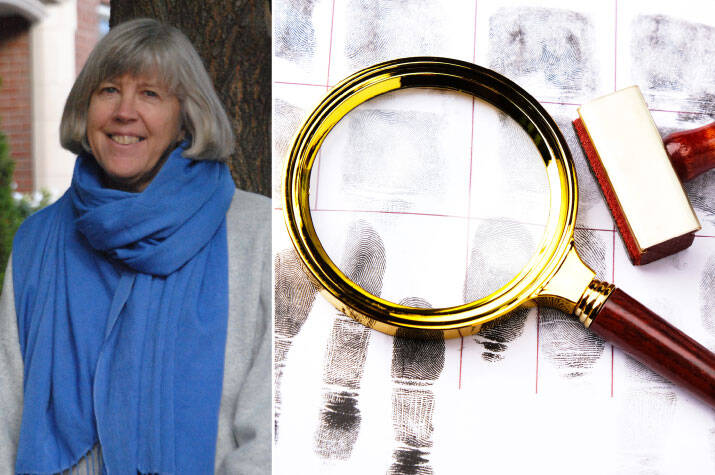
Wilkinson in October 2025, the day after learning she had been appointed a Member of the Order of Canada.
Image by Dr. Della Wilkinson
April 7, 2026
Content
Where do you begin an investigation when there's no crime scene, no body, and no clear path forward — only unanswered questions and families waiting for truth? That was the kind of challenge now-retired RCMP research scientist Dr. Della Wilkinson devoted her career to solving.
Over the course of her career Wilkinson studied how fingerprints, DNA, and other traces behave in real-world conditions — not just in controlled labs, but when exposed to fire, chemicals, biological contaminants, extreme temperatures, and difficult surfaces. Her work helped recover evidence that might have otherwise been lost. In December 2025, those contributions were recognized with an appointment as a Member of the Order of Canada.
“Forensic science plays a critical role in modern policing,” says Marie-Claude Dandenault, RCMP Deputy Commissioner of National Specialized Services. “By methodically analyzing crime-scene evidence, investigators can identify or exclude connections between people, victims, and crime scenes, which helps support justice for victims.”
Finding a starting point
The question of where to begin became painfully real amid the long-running crisis of Indigenous women disappearing along British Columbia's Highway of Tears. Without reliable crime scenes or physical evidence, investigators struggled to move forward.
Wilkinson approached the challenge from a different angle: how do investigators locate victims so the investigation can even begin?
She learned of early work at the National Research Council (NRC) of Canada, where scientists were using an emerging technology called hyperspectral imaging to detect disturbed soil and subtle changes in vegetation that could point to possible burial sites. A joint RCMP-NRC pilot in 2013 showed what the technology could do, but the equipment was still too large to be used in the field.
Wilkinson's role was to connect the policing need with the scientific avenue. She helped identify what would be required for the technology to become practical, including miniaturization and future drone-mounted use — advances that have yet to be realized. For her, it was a clear example of applied forensics: recognizing a real investigative problem and helping guide science toward a future solution.
“You don't always have the tool that you need,” Wilkinson said. “But when you understand the policing problem and you see the scientific potential, you can start bringing the two together.”
Science in the real world
Much of Wilkinson's career showed how scientific ideas become practical tools for police — often slowly, and with a lot of behind-the-scenes work. One example is when Canada switched from paper to polymer banknotes, a change that meant the fingerprint techniques used for decades suddenly didn't work anymore.
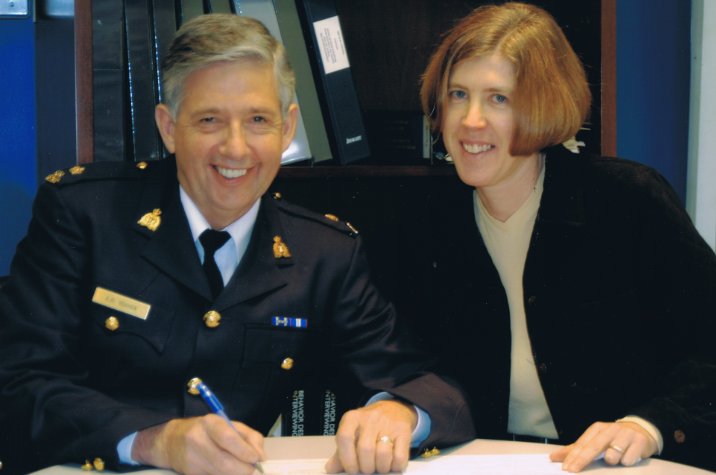
Image by Dr. Della Wilkinson
Wilkinson was part of a small international group of fingerprint experts who shared ideas and helped each other solve problems. If a technique stopped working or a new material behaved unpredictably, someone in the group had usually seen it before. That collaboration mattered: the method used on Canada's polymer banknotes was developed in the United Kingdom, but Wilkinson brought it into practise in Canada. She secured pre-circulation notes, confirmed the technique worked on Canadian currency, and ensured RCMP labs across the country had the equipment and training to use it.
Her work went beyond developing new tools. Wilkinson also supported some of the country's most complex investigations, including the Robert Pickton serial murder case. While forensic identification specialists carried out years of work at the crime scene, she helped them determine how to recover and interpret difficult evidence, including material that had been frozen or stored in challenging conditions.
An “aha” moment
A turning point came when Wilkinson learned more about the RCMP's Chemical, Biological, Radiological, Nuclear and Explosive (CBRNE) response teams. These teams were expected to collect evidence in hazardous environments using techniques designed for standard crime scenes.
With a background in chemistry, she questioned whether hazardous substances could change how fingerprints, DNA or other traces behave, and whether they could be recovered at all
“Why would we think that all the chemicals we use in a normal crime scene would work when there's a contaminant present?” she said. “Chemistry is kind of fussy that way.”
This led to a major line of research on how evidence reacts to chemical and biological agents. After the 2001 anthrax letters, the work became even more urgent and expanded into real-world, high-risk conditions. The results were significant. While many common techniques failed, some still worked — allowing officers to rely on tested methods rather than guesswork.
“Who wants to spend time using a technique that's not going to work?” Wilkinson said. “At least you know what has the potential to be successful.”
Strengthening standards
Later in her career, Wilkinson played a key role in strengthening how fingerprint evidence is understood and presented in court. She contributed to national and international standards and worked to make complex science accessible without oversimplifying it.
In 2010, she cofounded the Canadian Friction Ridge Working Group with two RCMP officers. The group brings together experts from across the country to develop standards that support the justice system.
Her expertise was later called upon during the re-trial of R. v. Bornyk in 2017, the first major Canadian court challenge to fingerprint evidence. The court ruled that fingerprint evidence was valid.
“Her research and testimony helped explain the science behind fingerprint identification and why it remains a reliable investigative tool,” says Assistant Commissioner Don Halina, head of the RCMP's Forensic Science and Identification Services (FSIS).
Legacy and partnerships
Much of Wilkinson's influence came from how she worked. She collaborated with identification specialists, academic researchers, and international partners, often acting as the bridge between cutting-edge science and operational policing.
“Dr. Wilkinson believed deeply in collaboration,” says Halina. “Together with her long-time research colleague Dr. Brian Yamashita, she helped build strong partnerships between academic institutions and policing agencies. Their work ensured that research did not stay on the shelf and translated into practical tools investigators could actually use.”
Her mentorship also shaped the next generation of forensic scientists. Many current practitioners first connected with Wilkinson as undergraduate or graduate students completing research placements tied to real investigative challenges.
After retiring, she carried that perspective into the classroom, reminding students of the responsibility that comes with the work and who it ultimately serves: victims and their families.
“Despite her impressive career, Della remains incredibly humble,” says Dr. Rolanda Lam, who worked closely with Wilkinson and succeeded her in 2020. “She wasn't in this work for the spotlight — it was about helping others and supporting victims. She left big shoes to fill, and her influence continues to guide how we support frontline policing today.”
Looking ahead
When asked what advice she offers to future scientists, Wilkinson keeps it simple: listen to the problems people are facing in the field, read widely, build networks, and stay curious.
“Success is never individual,” she said. “It depends on partnerships across disciplines, across Canada, and beyond.”
Colleagues describe her as someone driven by curiosity, humility and respect, who never stopped asking questions — not out of doubt, but out of a desire to understand how science could better serve investigators and victims.
Her appointment to the Order of Canada reflects more than a distinguished career. It recognizes a lifelong commitment to advancing her field in ways that help give victims a voice — always with the people at the heart of every case.