
RCMP attracts 911 operators from other agencies with new approach
By Alexandra Cotroneo
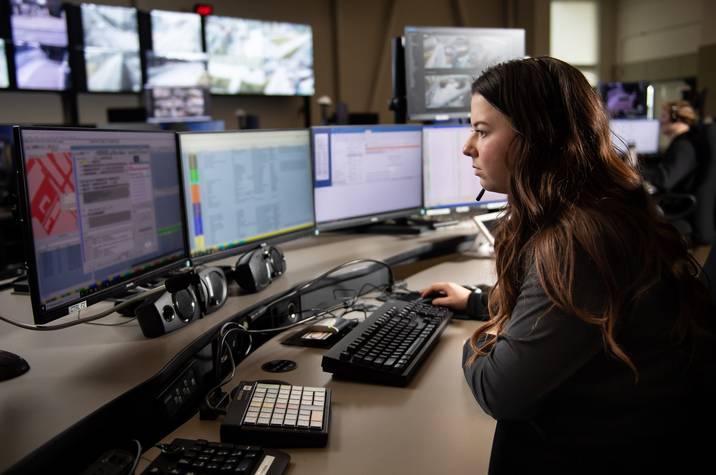
In areas of Canada where the RCMP is the police of jurisdiction, Operational Communications Centres (OCC) are the first to answer calls for help.
Image by Serge Gouin, RCMP
January 13, 2026
Content
As the first point of contact at the RCMP when someone dials 9-1-1, the RCMP's Operational Communications Centre (OCC) operators—also known as police dispatchers—play a vital role in public safety. By collecting essential information needed to safely dispatch emergency personnel to the scene, they are a critical part of the RCMP's operational and emergency responses.
But staffing has been an ongoing challenge, according to Matt Whysker, National OCC program advisor.
To help close that gap, the RCMP has introduced a new, accelerated hiring and training process to streamline the recruitment path for applicants who already have experience working as operators with other Canadian police agencies.
“We're trying to bring in people who already know the job,” says Whysker. “If you've been doing this for another agency within the last five years, you can apply through our new process.”
With roughly 833 operators nationwide, recruitment remains a top priority to address staffing needs and attract skilled professionals from across Canada.
Fast and flexible hiring
Previously, all new applicants had to go through a lengthy recruitment and training cycle, including classroom instruction and field coaching, regardless of experience. Under the new Experienced Operator Program that process is much faster for those who have already been doing the job.
Once hired, experienced operators are matched to the RCMP pay scale according to their prior experience and enter an accelerated training approach. This approach is modelled after the RCMP's Experienced Police Officer Program (EPOP) which recruits qualified police officers.
“They don't need to start from scratch,” says Whysker. “They're already trained in the essentials of emergency call-taking and dispatching. It's more about learning RCMP-specific systems, policies, and terminology.”
Operator perspective
For those who've made the switch, the new approach has already proven to be a rewarding opportunity.
“Being a dispatcher is rewarding in many ways, one is being able to do what I can to make sure officers are given all the information they need to stay safe during their shift,” says Kylie Patrick, an experienced dispatcher who recently joined the RCMP OCC in Nova Scotia through the Program. “There is no better feeling than being thanked by the public for the little assistance we provide.”
Patrick says the transition to the RCMP has been overwhelmingly positive.
“I am so happy that I made the switch to be with the RCMP,” says Patrick. “The staff are great, it's a very positive work environment, and the managers are incredibly supportive in offering any and all opportunities to grow as a professional.”
Being bilingual is also a valuable asset within the RCMP for Patrick.
“I've been able to use my bilingualism often here, which I love immensely,” she says. “It was much less frequent at my previous agency.”
Encouraging early success
Since its rollout in 2023, the Program has already attracted dozens of experienced applicants. Of 38 who applied in the first wave, 31 were approved to move forward.
The RCMP hopes this approach will not only speed up hiring but also make the role more appealing to operators considering a move from other agencies.
“It's definitely more enticing when people see that their prior experience is recognized, both in training and pay,” says Whysker.
Career full circle
Kyle Van Huizen began his emergency services career with the RCMP in 2009 but went on to work with other agencies across Ontario and Nova Scotia for 11 years.
“I love coming to work every day knowing the experience I bring can make a difference in someone's life during a time that things seem to be at their worst,” says Van Huizen.
In 2024, he returned to the RCMP.
“A big reason I made the move back was because of the Experienced Dispatcher Program,” says Van Huizen, who is now an OCC operator in Nova Scotia. “This is the first of its kind that I'm aware of in Canada, and it allowed me to have my years of experience credited.”
A career with national reach
Beyond faster hiring, one of the biggest draws of joining the RCMP as an operator is the opportunity to work in communities across the country, says Whysker. Van Huizen agrees.
“I started in Victoria, then went to Iqaluit, and now I'm in Ottawa,” says Whysker. “That kind of mobility and diversity of experience is something you don't find everywhere.”
According to Whysker, the RCMP's new Experienced Operator Program could be the ideal entry point or the next step in an operator's career for those interested in public safety, teamwork, and a career that offers both stability and adventure.