
Running toward gunfire at Parliament Hill, Part 1
Trigger warning: death, suicide
By Patricia Vasylchuk
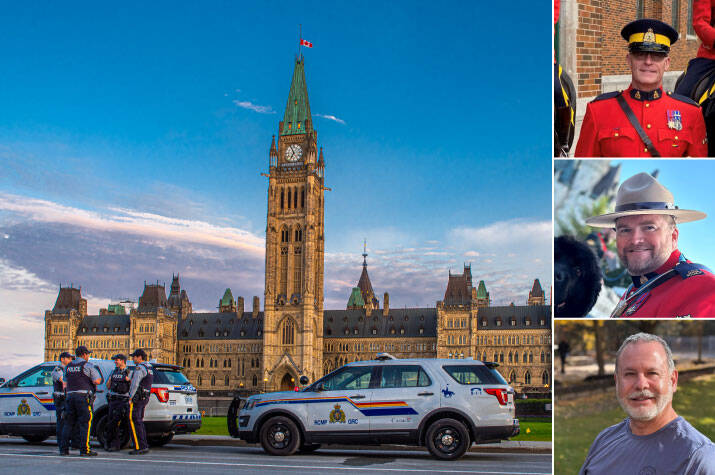
Rozon, Barrett, and Daigle were on-scene during the 2014 Parliament attack.
Image by Shutterstock and edited by RCMP
January 20, 2026
Content
Dishonour in the Hall
The morning of October 22, 2014 started out like most other mornings for then Sergeant Richard Rozon, Constable Curtis Barrett, Corporal Danny Daigle, and Constable Martin Fraser. Rozon was in line for coffee at Tim Hortons, and Barrett and Daigle were at the Parliamentary vehicle screening facility. But, just minutes before 10 am the three RCMP officers stood face to face with a terrorist unloading a .30-30 calibre hunting rifle in Parliament's Hall of Honour.
Rozon was the first of the three to arrive on scene minutes after receiving news over the radio of a man carrying a rifle on Parliament Hill. By the time the officers entered the Peace Tower less than three minutes later, the shooter had already exchanged rounds with security personnel inside.
“There were just clouds of smoke and gunpowder,” says Rozon, now a retired Staff Sergeant Major. “And there were a lot of people hiding behind pillars.”
Seconds after entering the building, Rozon, Barrett and Daigle, along with a fourth officer, Constable Martin Fraser, moved through the building in sync, using the Immediate Action Rapid Deployment (IARD) formation – a diamond-shaped structure of walking used by police during active-shooter situations. Barrett took the lead, Rozon and Fraser took the sides, and Daigle brought up the rear.
“At that point we didn't know what the shooter looked like, and all the security guards were in civilian clothes,” recalls Rozon. “There was so much confusion inside.”
Relying on teamwork and training, the group of four made its way through the building with guns drawn. Having worked closely with the building security teams, Barrett helped his colleagues identify when not to shoot by occasionally calling out “Friendly!”.
“I thought I was going to die that day – a hundred per cent,” says Barrett, now a Sergeant, recalling the moment someone yelled, “He's got a shotgun! He's got a shotgun!”
Facing a killer
Suddenly the shooter's gun barrel came into view from behind a stone pillar and the officers readied themselves for a confrontation. Seeing the four Mounties, the shooter – Michael Zehaf Bibeau – began firing, and the exchange of bullets began.
Suddenly, Rozon felt a hard hit against his chest that threw him back.
“I thought I was hit. It felt like I got punched hard on the chest, and it took me off balance, but the adrenaline kept me going,” says Rozon who later found traces of dust but no bullet hole on his uniform. He found out later the hit came from debris from a bullet that has ricocheted off a stone.
Then, in a momentary window of opportunity, Zehaf-Bibeau stopped firing to re-load his gun, according to Rozon. The four officers rushed toward the suspect. Barrett started firing from where he stood in front of the shooter and to the left of Rozon. At the same time, the House of Commons sergeant-at-arms Kevin Vickers, who had been taking shelter on the other side of the stone pillar from Zehaf-Bibeau, jumped to the ground between Rozon and Barrett to get a clear sight of Zehaf-Bibeau, and started firing up.
After multiple rounds to his body, the shooter remained upright.
“I shot him 14 or 15 times, and he was standing on his feet,” says Barrett. It was a final bullet to the head from Barrett – later confirmed in the coroner's report—that finally took Zehaf-Bibeau down. The whole thing – from when the officers entered the building until the end of the shootout—happened in under 3 minutes.
Having received reports of a possible second shooter – now known to be false – the RCMP officers, along with the Ottawa Police Service, the Senate and House of Commons protective services, and additional RCMP officers, continued working well into the evening to ensure there was no longer a threat to public safety.
A troubling aftermath
That evening, Rozon, Daigle and Barrett were asked to hand over their weapons and were escorted home to begin a mandatory leave while the officer-involved death incident was investigated. They were instructed not to talk about the incident.
Even the subsequent offer of a group debrief session a week later, which was also open to all RCMP employees at headquarters, didn't provide the solace they needed to bounce back.
The inability to effectively talk about what happened and process the events on the Hill and the aftermath led Rozon, Barrett, and Daigle down a dark spiral.
In Parts 2, 3, and 4, we dive into each officer's personal mental health journey as they each navigated their pain and recovery in the aftermath of the shooting.