
Next Generation 9-1-1
On this page
Overview
Canada is modernizing its emergency communications system, replacing the aging analog system with an IP-based or digital network. This upgrade to Next Generation 9-1-1 or NG9-1-1 reflects today’s mobile phone technology, designed to support safer, faster and more informed emergency responses. The new technology will be able to take advantage of all the increased options for information sharing that many of us use on a daily basis.
Transcript
[background music]
Our 9-1-1 system is about to change.
[Graphic of person calling 9-1-1 on a mobile phone.]
Right now, the system operates over an analog network designed decades ago with landlines in mind.
[Graphic of 9-1-1 dispatcher.]
[Graphic of telephone poles and red landline phone.]
Today, we know the majority of 9-1-1 calls we receive are made on cell phones.
[Graphic of 9-1-1 dispatcher speaking to person on a mobile phone.]
The old system is being replaced with next generation 9-1-1 or NG, which is an internet protocol-based digital network.
[Graphic text “Next Generation 9-1-1”]
[Graphic of 3 computers connected to the internet.]
This change has been mandated by the federal government and will modernize 911 systems here in BC and across Canada.
[Video of Canadian flag mounted on side of building.]
[Graphic of mobile phone dialing 9-1-1 overlayed on map of Canada.]
So, what will next generation 9-1-1 mean? The launch of NG lays the foundation for safer, faster, and more informed emergency response.
[Graphic of mobile phone with text “Next Generation 9-1-1” beside a question mark.]
[Graphic of 9-1-1 dispatcher beside building blocks.]
[Graphic of Police, Fire and Ambulance vehicles and logos.]
In future years, NG will lead to new kinds of information sharing with 9-1-1, including real-time texting and sharing of live stream video.
[Graphic of clock with arrow pointing to mobile phone with text “Next Generation 9-1-1” ]
[Graphic of 9-1-1 dispatcher and mobile phones receiving a text message, taking a photo and playing video.]
NG will also help provide enhanced location details through GPS and geographic information systems or GIS to ensure help gets to where it's needed as quickly as possible.
[Graphic of mobile phone with text “Next Generation 9-1-1” beside street with location icon.]
[Graphic of map with location icon and Police, Fire and Ambulance vehicles.]
With NG, people will still be able to call 9-1-1 when they need help, just like today. And in the future, there will be more ways to share critical information with call takers and first responders as they work to protect the public and save lives.
[Graphic of man making a call on mobile phone to a 9-1-1 dispatcher.]
[Graphic of mobile phones receiving a text message, taking a photo and playing video.]
[Video of 9-1-1 dispatcher speaking in front of computer screens.]
[Text graphic “E-Comm 9-1-1”]
[Text graphic “Royal Canadian Mounted Police | Gendarmerie royale du Canada”]
As the federal regulator of all telecommunications service providers which connect emergency calls to first responders, the Canadian Radio-television and Telecommunications Commission (CRTC) has mandated the transition to the new digital network NG9-1-1 with a deadline of March 31, 2027.
What the public can expect during implementation
The transition to NG9-1-1 will happen behind the scenes and will be largely invisible to the public. Callers will continue to dial 9-1-1 as they do today and speak with a call taker, who will ask for their location and whether they need police, fire or ambulance. Calls will continue to be transferred to the appropriate emergency service.
The only immediate public-facing change will be the introduction of a new automated callback system for managing 9-1-1 calls that are quickly disconnected or abandoned. Read below for more information on the new automated callback system operated by E-Comm.
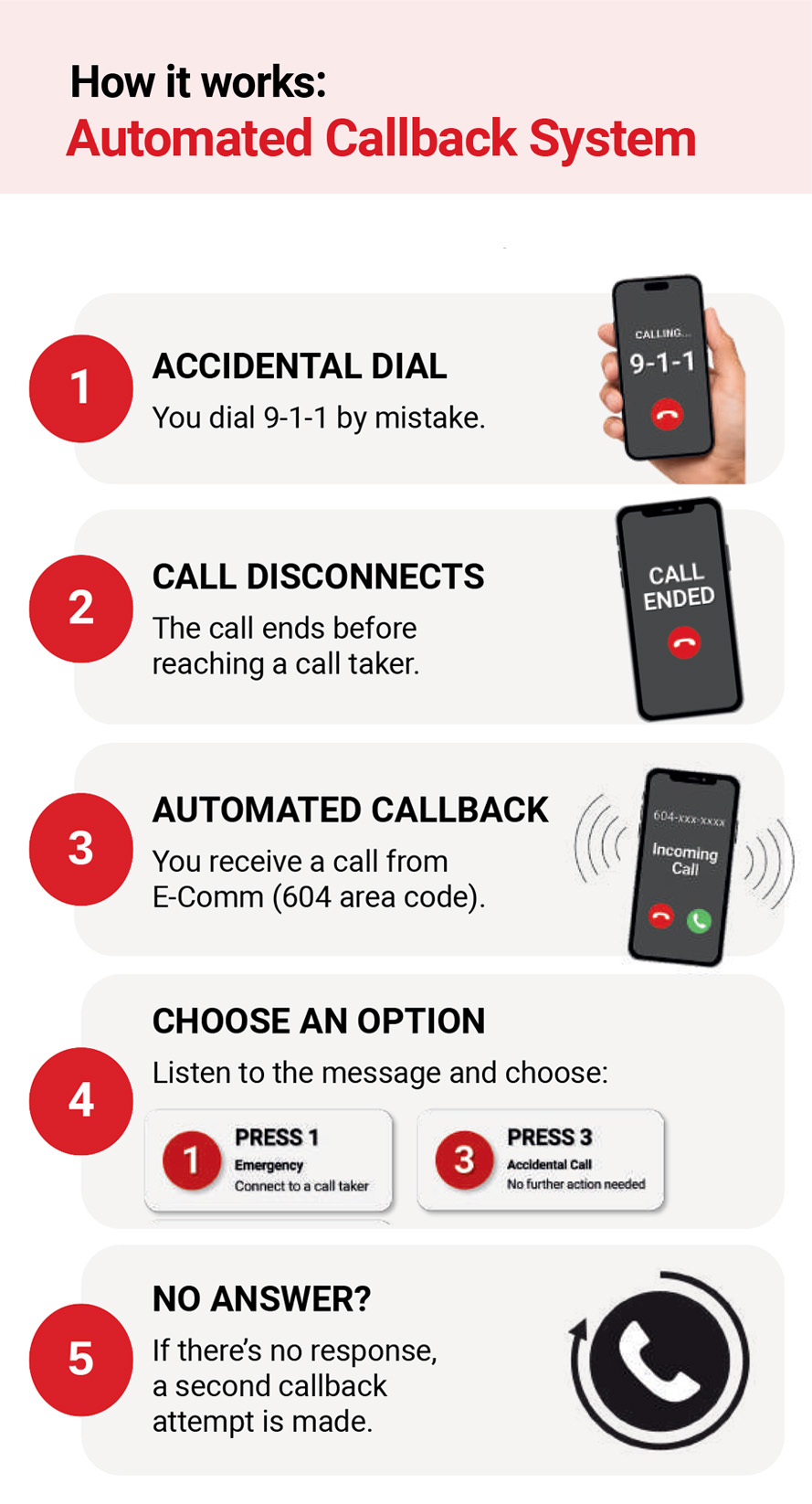
Automated callback system
The new automated callback system is fully managed and maintained by E-Comm. It will automatically call back when an abandoned 9-1-1 call is detected, before reaching a call taker.
The caller will hear a voice recording letting them know their phone dialed 9-1-1 and provide them with two options: press one to be connected to a call taker if their call is regarding an emergency, or press three to indicate an accidental 9-1-1 call, and no further action will be taken. The message will repeat three times prior to the call disconnecting. If there is no response to the first call back, a second automated call back will be made by the system.
Currently, quick hang up calls may not receive a follow-up if it is not detected in the system.
Will the automated callback system be activated for all abandoned calls?
The new system will not be used to respond to open line abandoned calls, where the call reaches a call taker before disconnecting. For those abandoned call types, a call taker will continue to place two manual call backs as they do today, based on standard operating procedures.
When will the new automated callback system launch?
The system will launch during the first phase of the transition and is expected to be operational for 9-1-1 callers from October 6, 2026 and onwards.
What happens if the caller doesn’t pick up the automated call, or doesn’t select one of the options?
No further action will be taken, which is aligned with the current call back practice when a caller doesn’t pick up or voicemail is reached. The new system will follow the same procedure for both cell phone and landline calls. For open line abandoned calls with no response, call takers will continue to follow current policies based on the relevant police of jurisdiction.
Is there a risk some true emergency calls could be missed if there is no response to the automated call back?
The automated system will ensure all quick hang ups prior to call taker pick-up receive an automated call back, unlike today. Currently, some very quick hang ups do not receive a call back, as their call information never comes through to a 9-1-1 dispatcher. While no system can eliminate risk entirely, automated call backs for quick hang ups will also allow call takers to focus on active emergencies. Similar automated callback systems for quick hang up calls are already in use in other jurisdictions across the country, including Peel Region and Toronto, with the technology operating successfully in Canadian communities.
Does the automated system recognize voices or background noise?
Voice and sound recognition are not expected to be initial features of the system; however, these functions will be sought for future iterations of the software.
What will people see on their phone displays when automated system calls, and how will they know the call is legitimate?
A call back from the automated system will display as a ten-digit number beginning with a 604-area code. If someone calls the number back, they will hear a message indicating they have contacted E-Comm and to call 9-1-1 if there is an emergency.
Will the automated callback system have options for those who speak languages other than English?
The system’s initial phase will incorporate English-language messaging only. Recognizing that some callers may experience language barriers when receiving an automated callback, E-Comm has a public education campaign underway for the new system so that callers who get this recording, despite having a language barrier, can press 1. If someone contacts 9-1-1 and requires service in a language other than English, call takers can access a 24-hour interpretation service for over 200 languages.
How will the new automated system work for those who are deaf/hard of hearing?
Accessibility services including Text with 9-1-1 and Teletype Writers (TTY) will continue to be available with the launch of Next Generation 9-1-1. For Text with 9-1-1, when a 9-1-1 call is made from a registered user, the call taker receives an alert and will initiate text communication. In the event a 9-1-1 call from a registered user was quickly hung up before connecting to the call taker, the system would place up to two automatic calls back. Through public education, E-Comm will inform all callers who receive a call back after accidentally dialing 9-1-1 to press one for emergency help, and three if the call was accidental.
Frequently asked questions
What is NG9-1-1?
Next Generation 9-1-1 (NG9-1-1) is a new IP-based or digital network that will replace the current aging analog system for 9-1-1 calls. The new technology is designed to support safer, faster, and more informed emergency responses.
Why are we transitioning to NG9-1-1?
The transition to NG9-1-1 has been federally mandated across Canada by the Canadian Radio-television and Telecommunications Commission (CRTC). Canada’s current analog system was designed decades ago primarily for landlines, and the aging infrastructure needs replacing. The CRTC has set a deadline of March 31, 2027, for the national transition and British Columbia is on track to take place ahead of that time, by the end of 2026.
Benefits
What are some of the key benefits of NG9-1-1?
The transition to NG9-1-1 lays the foundation for safer, faster, more informed emergency response. The first phase, launching this fall, migrates voice 9-1-1 calls to the new network. In the future, NG9-1-1 will allow for capabilities such as real-time texting to 9-1-1, sharing of streaming video, as well as enhanced location details through GPS and geographic information systems or GIS to ensure help gets to where it’s needed as quickly as possible. These are future-state capabilities and are not part of the first transition phase in 2026.
When will capabilities like real-time text be available in B.C.?
A timeline is not yet known for when real-time text to 9-1-1 will be available in B.C. and timing will be largely dependent on further direction by the CRTC on a national rollout.
Impact
What changes can the public expect with this transition?
The transition to NG9-1-1 will happen behind the scenes and will largely be undetectable to callers who dial 9-1-1. Callers will reach a 9-1-1 call taker just as they do today who will ask if they need police, fire or ambulance, and for which location. The call will then be directed to the proper agency for call-taking and dispatch just like today. From a caller perspective, the transition to NG9-1-1 will be invisible. The only immediate public facing change will be how quick hang up 9-1-1 abandoned calls are handed.
Will anything change for how the deaf, hard-of-hearing or speech impaired (DHHSI) access 9-1-1?
There will be no immediate changes to how people who are deaf, hard-of-hearing or speech impaired access 9-1-1. Text with 9-1-1 (T9-1-1) is a specialized texting service available that provides 9-1-1 call centres with the ability to converse via text messaging with a DHHSI person during an emergency. Registration is required for this service. To register visit: www.textwith911.ca. With future capabilities on the horizon with NG9-1-1, there will be more options for a DHHSI person to connect with emergency services.
Will there be any impacts to 9-1-1 service during the transitions?
BC RCMP, in conjunction with E-Comm and other emergency partner agencies, has a thorough plan in place to mitigate potential disruptions to 9-1-1 service. Ensuring the continuity of emergency communications services throughout the migration to NG9-1-1 has been a top priority for the project team.
What measures are in place to safeguard the NG9-1-1 network?
With the introduction of NG-9-1-1, technology complexity will significantly change. Ensuring business continuity and technology resiliency is paramount. The NG-9-1-1 call handling system is designed with multiple layers of redundancy - spanning system, data centre, and remote site levels - to minimize the impact of technology failures and other service disruptions.
Funding and timeline
What is the timeline for transitioning BC RCMP dispatch to NG9-1-1?
E-Comm is responsible for transitioning other dispatch agencies, including the BC RCMP, to NG9-1-1 using a phased and gradual approach. BC RCMP is scheduled to transition to NG9-1-1 between October 26 to November 9, 2026.
How is Next Generation 9-1-1 implementation being funded in B.C.?
In March 2023, the Province provided E-Comm with $90 million towards the initial implementation of Next Generation 9-1-1. The one-time funding has helped to offset start-up costs, resulting in a significant savings for local governments and agency partners. An additional $60 million in provincial funding went to the Union of BC Municipalities (UBCM) for implementation associated with emergency communication centres, including for the police and fire agencies who do not contract with E-Comm for their dispatch services or who are not part of E-Comm’s NG9-1-1 program. It’s also important to note that implementation funding does not cover ongoing costs related to NG9-1-1 after 2026.
- Date modified: