
RCMP Air Services offers unique careers in policing
By Sydney Treanor
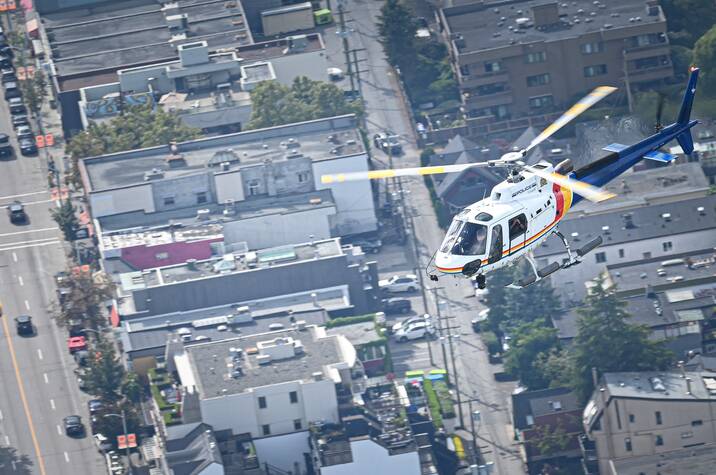
RCMP Air Services conducts aerial operations over Vancouver, British Columbia, providing support to frontline policing and public safety initiatives.
Image by Angus Morrison
October 19, 2026
Content
From supporting frontline operations in busy cities to connecting remote northern communities, the RCMP Air Services Program plays a critical role in policing across Canada. Behind every mission is a team of highly experienced pilots who bring years of aviation expertise to the organization before completing specialized training that prepares them for a unique career in law enforcement.
Training to take flight
It all begins at Depot–the RCMP training academy–in Regina, Sask. with the Air Services Special Constable Program.
"We built the program from the ground up," says Christine Hudy, manager of training program support and evaluation. The program was developed after RCMP pilots transitioned from police officers to special constables, who are appointed for specific and targeted duties. This change prompted the requirement for peace-officer status and additional law-enforcement training. The curriculum was designed to ensure pilots are equipped with the knowledge and skills needed to support policing operations across the country.
Unlike cadets, Air Services trainees arrive to the RCMP as experienced pilots who have already met Transport Canada's rigorous requirements. During the eight-week program, they complete a condensed version of basic training, which includes firearms, and drill and deportment—the training of marching, posture, and uniform standards.
"The training is very demanding," says Hudy. "But many pilots discover a side of the profession they never expected: They come to the RCMP to fly airplanes and helicopters and find themselves learning skills associated with law enforcement."
Support from above
For helicopter pilot Angus Morrison, who flies the Airbus H125 helicopter that training opened the door to a career that combines aviation with frontline policing.
Morrison, who lives and works in Vancouver, joined the RCMP in 2025 after nearly two decades in air-ambulance operations, firefighting, and rescue-related roles in northern Canada.
Morrison helps provide aerial support during policing operations throughout British Columbia's Lower Mainland. Air crews like Morrison's respond to serious incidents, locate suspects, and provide critical situational awareness to officers on the ground using advanced camera and thermal-imaging systems.
"We provide a vantage point you can't get from the ground," Morrison explains. "Our goal is to get overhead before anybody else and maintain a perimeter until officers arrive."
Tracking suspects while coordinating with air traffic control, maintaining awareness of the environments, and supporting policing operations requires a unique set of skills that pilots continue to develop throughout their careers.
Morrison says despite having arrived at the RCMP with thousands of flight hours, the organization introduced him to new experiences.
"Patrol flying is quite challenging," he says. "There's a lot more to it than people might expect."
Community connections
In Prince Albert, Saskatchewan fixed-wing pilot Kane Bobinski's work looks very different.
Bobinski joined the RCMP after a lengthy aviation career that included flying medical evacuation missions, northern transportation routes, and supporting wildfire operations. While he enjoyed the work, the demands of seasonal deployments and time away from home eventually led him to explore opportunities with Air Services.
Today, Bobinski is one of three RCMP pilots operating from the Prince Albert Air Services base. The team provides transportation support throughout Saskatchewan and beyond, moving officers, specialized teams, and prisoners while supporting policing operations in remote communities.
Although scheduled flights form part of the workload, priorities can shift quickly. Emergency response teams can require transportation at short notice; prisoner transfers can arise unexpectedly: and aircrafts are regularly deployed across the country to support operations elsewhere in Canada.
"Atypical days are our normal," Bobinski says.
Having spent years flying throughout Saskatchewan's north, Bobinski understands the vital role aviation plays in remote communities.
"It's like a lifeline," he says. "We bring specialists, technicians, and officers into communities. Being part of the operation and feeling like I did my job so they can do theirs is really how it's supposed to work."
More than flying
Regardless of their role, Air Services pilots share a common experience: they arrive as highly skilled aviators that become part of a larger policing mission. For Hudy, that's what makes the program unique.
"We're always very happy and proud to be part of shaping the pilots in our organization," she says.
For Morrison and Bobinski, the role offers the opportunity to combine a sustainable lifestyle with meaningful service to Canadians.
"Of all the aviation jobs I've had, this is almost a perfect balance," Bobinski explains. "It's all about lifestyle for me."
Morrison says he's always enjoyed jobs where he can contribute.
"This role fits my interests. I get to contribute, make a good living and see my family at the end of the day," he says.
And for pilots considering their next career move, RCMP Air Services presents a path that's much more than flying. For Bobinski, that broader purpose has made all the difference.
"I could easily see myself being here until retirement," he says.