
Running toward gunfire at Parliament Hill, Part 2: Signs of trouble
Trigger warning: death, suicide, mental health
By Patricia Vasylchuk
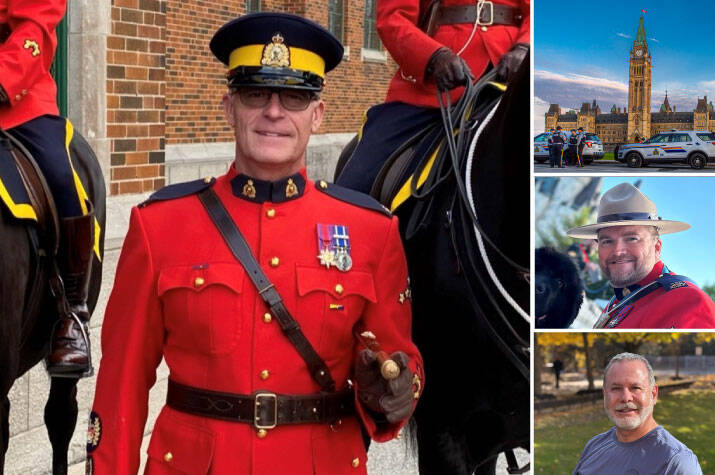
Now retired Staff Sergeant Major Richard Rozon proudly displays the RCMP Red Serge
Image by Richard Rozon
January 24, 2026
Content
While the morning of October 22, 2014, started out like any other, it wasn't even 10 a.m. when then Sergeant Richard Rozon, Constable Curtis Barrett, Corporal Danny Daigle, and Constable Martin Fraser stood face to face with a terrorist unloading a .30-30 calibre hunting rifle in Parliament's Hall of Honour. Read Rozon's journey of the aftermath in part 2 of the Gazette's 4-part series Running toward gunfire at Parliament Hill. If you missed Part 1, read it now.
Early warning signs
It didn't take long for Rozon to return to work – within a week he was back on the Hill. Looking back, he admits there were signs of trouble early on, but he wasn't aware of them then.
"I would work all day, did overtime until 10 p.m., went to sleep. And I was up in the morning at 3 because I couldn't sleep,” says Rozon. “The longer I went, the less I slept, until I wasn't sleeping at all. I did this for months."
But his coworkers were seeing a big change in Rozon's behaviour and they brought their concerns to the Officer in Charge (OIC), who suggested he might benefit from talking to a professional.
“They started seeing that things were off with me, that I was not joking or having fun anymore," says Rozon, adding that even after this he didn't think there was anything wrong.
"I thought I was OK; I thought I was just tired. I was functioning,” he says. And he continued working and not sleeping. But, as time went on, his colleagues saw Rozon worsen, and this time he was told he no longer had a choice. He had to go talk to a professional.
Difficult road to healing
After an initial mental-health assessment by RCMP health services, Rozon was told he had severe PTSD and had to stop working immediately. An independent psychologist soon confirmed the diagnosis.
“I didn't believe it; I've been through worse. I'm an adrenaline junkie. I run toward that stuff. I've been shot at several times, had my police cruiser rammed, got dragged by a car 100 feet. I've been through lots and it never really bothered me, I never lost sleep over it,” he says. “I thought, 'The psychologist doesn't know me.' But she's telling me how I am in my every-day life and she's hitting the nails everywhere. And she said, “Were you acting like that before?” And I said no. And she says, 'This is PTSD.”
Rozon heard that the Parliament attack was likely the last drop of water in an already-full glass that made the water spill over.
The moment he understood what PTSD looks like and how it develops, Rozon's road to healing began. But he says the following year of recovery at home proved extremely difficult.
“It was terrible. I felt guilty being home every single day. I felt shame that I was being paid but wasn't working,” says Rozon. “I didn't want to leave my house. From time to time when my wife made me go out do the groceries or something, if I saw someone I knew in public, I would turn around and walk in a different direction.”
Hurt people help people
Along the way, Rozon discovered that the medication he was prescribed for PTSD didn't help him – instead, it left him disconnected and suicidal. His doctors agreed he needed to stop taking it.
Over time and many counseling sessions with multiple psychologists and psychiatrists, Rozon began to come out of the darkness.
It was around this same time he discovered that sharing his story in an effort to help others on a similar path also helped his own recovery.
“If I can save one person's life by telling them what I went through, for them not to do what I was going to do, I'm happy,” he says.
Returning to work
One year later Rozon returned to work part time, even though his medical team advised he could benefit from more time at home.
“I felt that I would be more myself, feel better in my head, if I was back as a member doing my job,” he says.
Over the next several years Rozon worked in several administrative positions including building security. The return to work proved good for his mental health but the PTSD had left its mark.
On the job Rozon noticed he was having difficulty with his memory and retaining information.
“Before, I could read a page full of information, and I would remember everything on that page,” says Rozon. “Now, I just can't retain.”
Family support
Accepting a new version of himself hasn't been easy for Rozon.
“The old me was not perfect. There's some improvement, but I'm not the guy [my wife] met,” says Rozon. “I've learned a lot of things but sometimes I can lose it.”
Rozon credit's his wife's support as a major part of his healing, even participating in counseling sessions to learn how to best help him.
“She knows when it is time to just back off and she knows I'll come back down and we can talk about it,” says Rozon. “I'm glad she's OK with the new me, and the good thing is she's so good, she knows how to deal with it.”
Retire and repose
Rozon retired in 2024, but the inability to work at his full capacity still weighs heavily on him.
“I never came back 100% as a contributing member,” he recalls. “I'm walking out with my head down because I could never contribute the way I should have been, or I would have liked to.”
Just before his retirement, his boss wanted to honour his career in a ceremony and award presentation, but Rozon respectfully declined.
“I don't want any presentation. I just want to go below the radar," he says.
But others don't share his perspective.
“My boss told me: 'If you were not there on October 22, a lot more people would be dead today,' and I hear that.”
Rozon is now using his experience to help where he can, stating: “Am I healed? Well, when I meet officers in public I don't run anymore, I can talk to them, so there's that.”
Coming soon: Parts 3 and 4, the personal journeys of Corporal Danny Daigle and Sergeant Curtis Barrett in the aftermath of the 2014 attack on Parliament.