
Running toward gunfire at Parliament Hill, Part 3: Erased from history
Trigger warning: death, suicide, mental health
By Patricia Vasylchuk
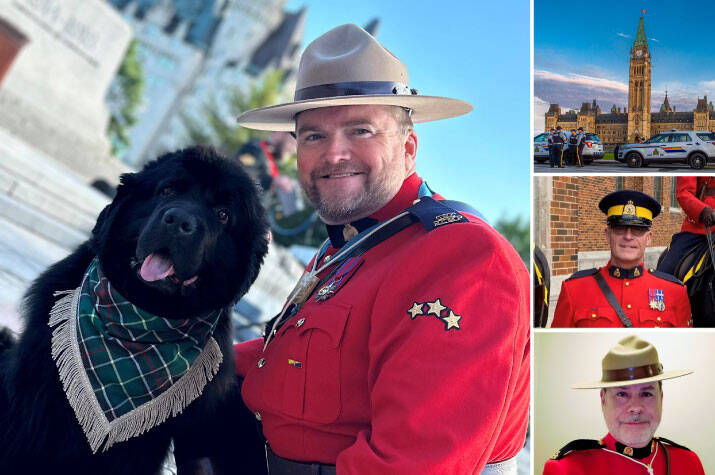
Sergeant Curtis Barrett
Image by Laura Barrett
March 6, 2026
Content
While the morning of October 22, 2014, started out like any other, it wasn't even 10 am when then Constable Curtis Barrett, Sergeant Richard Rozon, Corporal Danny Daigle, and Constable Martin Fraser stood face to face with a terrorist unloading a .30-30 calibre hunting rifle in Parliament's Hall of Honour. Read Barrett's journey of the aftermath in part 3 of the Gazette's 4-part series, Running toward gunfire at Parliament Hill. If you missed Parts 1 and 2, read them now.
Shots fired
“We're walking down the hallway and everybody's hiding and there's this strong smell of gunpowder; when someone yelled, “He's got a shotgun!” I thought I was gonna die that day,” Barrett recalls facing the shooter, Michael Zehaf Bibeau, who had positioned himself behind a stone pillar.
“I saw the barrel of the rifle come around and he lined up to shoot at us,” says Barrett. “He shoots and it hits a stone carving right next to me, and it breaks off a big chunk.”
The pieces of stone missed Barrett and hit Rozon. Barrett recalls seeing Rozon's body get pushed back with the impact and thought he had been shot. This pushed him to sharpen his focus on doing everything to take down the shooter.
“Every time more of his body popped out from behind the pillar I shot,” he says. After firing more than a dozen rounds, Barrett was surprised that Zehaf Bibeau was still standing. He says the medical examiner later told him why.
“My first rounds hit Bibeau's legs. He had a pocketful of .30-.30 rounds, and [mine] were hitting his rounds; they stopped [my bullets] from penetrating his thighs or his legs,” Barrett says adding that the rounds that hit the shooter's ribs also weren't fatal. “Instead of breaking through, they were actually riding around and exiting out his back.”
A final, fatal shot to the head from Barrett ended the battle.
“[Constable] Martin Fraser asked me if he should handcuff him and do First Aid - Police officers are not doctors, we cannot declare someone deceased - I said yes,” says Barrett. Police are trained to protect every life. Even in a situation like this, they do what they can to provide life-saving aid.
Clearing the building
After confirming that Bibeau was absent of life signs, Barrett and the other RCMP officers proceeded to clear the rest of the building of any other possible threats. While clearing a senator's office Barrett caught the tail end of a news clip on the TV.
“It said a Canadian Forces soldier was killed near Parliament, and my heart sank. At that point, to my knowledge, only the bad guy I just shot was dead. I didn't know about Nathan Cirillo.” says Barrett. “I thought I just killed a veteran. I thought I was gonna vomit.”
In another room Barrett found a group of members of Parliament secured behind locked doors and told them they were safe. One of them asked Barrett how he could be sure.
“I said to him, 'Because I just shot him in the head',” says Barrett. “He thanked and hugged me.”
Misinformation starts
In the meantime responding law enforcement was getting conflicting reports and misinformation was spreading fast. Barrett says he was first made aware of it when a commanding officer came to him asking if Barrett knew of anyone that had seen the incident unfold.
Shocked, Barrett responded: “'I saw it. I was there. I shot the guy,' and he said, 'Oh no, we're being told Kevin Vickers did everything.' I couldn't believe it.”
And the quagmire of information being pieced together by the media was no different. As news of the attack spread, press coverage of the event inaccurately hailed then Sergeant-at-Arms Kevin Vickers as the sole hero in the operation.
“The next morning I'm drinking coffee watching the news seeing people I protected the day before give Kevin Vickers a hero's applause, and there's no mention of us,” says Barrett.
As a result, Barrett and his colleagues' actions that day were called into question by the public, the media, politicians, and the RCMP itself. The incomplete storyline that came out immediately after the shooting is where Barrett says the damage lies.
No one believed
Eight months later, on June 4, 2015, after a thorough investigation, the RCMP released a report confirming the officers' actions on the Hill. It was first presented to the House of Commons and later, a heavily redacted version with the officers' names censored, was made available to the public. It did little to change what the public had been presented as truth for over half a year.
He waited for months, hopeful the media would start asking more questions. When it didn’t, he took matters into his own hands. With permission from his commanding officer and with an RCMP media liaison present, Barrett met with a journalist to tell his story. But the story didn’t garner much attention, and it did little to change public perception. The lack of public acknowledgement of the truth affected Barrett deeply leaving him feeling damaged.
“Even today, the majority of people have no idea that RCMP officers were involved in the shooting,” he says frustrated.
Searching for help
Meanwhile, in the days after the shooting, Barrett says no one from the RCMP checked in to see how he was doing so he ended up reaching out for help himself to the person who was his assigned staff relations representative.
“I would send a message or an email or leave a voicemail, and it would be four or five days before anybody would get back to me,” he says.
About a week after the shooting Barrett went to the only briefing offered to the officers. But it wasn't what any of them expected.
“There were hundreds of members there. And they were talking about everything so generically,” says Barrett. “No one in the room knew that there were four people in the room that had been in the shooting. It made me so upset that I went to the bathroom and threw up.”
“I wanted someone to explain to me how this is happening - how no one knows that we shot this guy,” says Barrett.
Tensions build
A day after attending Cirillo's funeral Barrett came home and found his dog unable to move on the floor. After taking her to a vet was told the only option was to put her down. The build-up of trauma was too much. He reached out multiple times to his RCMP-issued mental-health liaison in tears.
It took days for the person to respond to him, and when he finally did, Barrett was met with resistance. Barrett says that he found out years later that his colleagues were told not to talk to him about the incident while members of senior management told him they thought “someone else was taking care of it.”
“They dropped the ball,” he says.
Returning to work two months after the shooting, Barrett continued to see the toll on his mental health.
Making matters worse, three months of the RCMP not releasing any details his own girlfriend started to doubt the story. “She said that after this much time, the information would have been released if what I was saying was true,” he adds. The relationship ultimately failed, which added to his already weakened mental health.
Taking the updated Immediate Action Rapid Deployment (IARD) training was one incident that stood out.
“After getting shot at during the training, the instructor asked me if I was OK because my eyes were as wide as saucers,” he says.
He found solace and support from one officer, his colleague Constable Karl Delisle, whose selfless support left Barrett deeply grateful.
“Karl arranged to find a 24-hour Vet, helped me load my dog into a police vehicle, went with me to the vet, and then explained to the vet what I had been through in the past days. The vet refused to charge me for the vet visit thanks to Karl. Karl also attended the funeral of Cirillo with me and looked after me.”
Turning point
About a year after the shooting Barrett, on advice from one of the other officers involved, went to Veterans Affairs Canada (VAC) to ask questions about potential support related to his involvement in the shooting. He was shocked when VAC told him the organization couldn't help him because there was no record of him being involved in a shooting.
“That was the breaking point,” says Barrett. “I drove straight to RCMP headquarters and walked into Health Services.”
Upon hearing what Barrett had endured over the last year, the Health Services Officer arranged for Barrett to go to an Occupational Stress Injury (OSI) clinic. It was the first real bit of help Barrett had received since the ordeal began. “The OSI saved my life, I think,” he says.
Self-healing and healing others
In 2022 Barrett learned of the RCMP's National Reintegration Program (NRP). The Program, which launched in 2020, is designed to support officers returning to operational duties after critical incidents, psychological injury, or extended absences. After participating, Barrett made noticeable strides in his mental health but admits that pieces of the trauma still linger.
“It was so exhausting mentally, but I pushed through it and I got through it and I'm very happy to have done it, but there's a little thing where deep in your brain, no matter where you are, it knows that this hurt the last time you experienced this,” he says.
After talking about his own experiences with officer aftercare during an NRP class, he joined the Program, travelling and presenting alongside the facilitator. For months he flew across Canada speaking to people about his experiences and what helped him recover. In August 2022, he joined the Program as a facilitator, and then as a divisional coordinator in Quebec in May 2025.
“My job was to talk about mental health and help bring people back after traumatic events—do all the things that didn't happen for me,” says Barrett.
Signs of progress
Two years after the attack Barrett was asked by the RCMP to record a video talking about the shooting and what lessons can be learned from it. Years later, he found out from colleagues that it's being used as training material for the Initial Critical Incident Response (ICIR) 200 course.
Barrett also learned that the video footage from the day of the shooting, which shows Barrett, Rozon, Daigle, and Fraser moving through the hallway with guns drawn, is being shown to cadets at Depot, the RCMP training academy.
On the 2nd anniversary of the shooting, Barrett visited the Cenotaph in Ottawa, and did Sentry Duty days later on Remembrance Day.
“I wanted to prove to myself that I could stand where Nathan (Cirillo) had been executed,” says Barrett. “It was very potent.”
Barrett says he's made progress, but the events of October 22, 2014, and the aftermath still haunt him.
“I tell people to keep an eye on themselves because mental health issues can sneak up on you quickly,” says Barrett. “The stigma around mental health still exists, and sometimes it's a struggle for me, but not be afraid to speak out about it.... The organization is made up of mostly wonderful people, don't let the few bad apples make you give up.”
If you're an RCMP officer want more information about the National Reintegration Program, email the Program at: reintegrationprogram-programmedereintegration@rcmp-grc.gc.ca.
Part 4 is coming soon.