
10-33: An RCMP veteran’s story of survival
Trigger warning: suicide, mental health
By Robin Percival
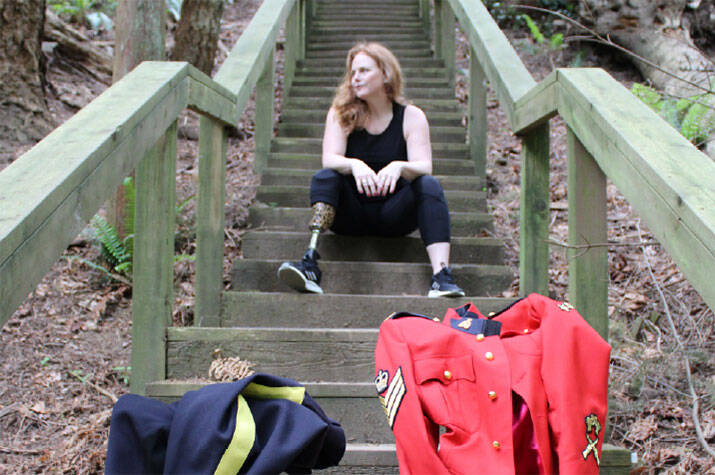
Retired member Laurie White in 2021.
Image by Jesse Pound
August 26, 2026
Content
On a November afternoon in 1998, Constable Laurie White and two other officers were executing a search warrant at the home of a sexual offender. While trying to gain access, standing to one side of his carport door, she suddenly heard a loud “pop.”
“I tasted the chalky residue. I smelled the smell of gunpowder. I looked down and I saw grayish smoke coming from my shin. And then I saw a black hole in the white door. And I said to my partner, “I've been shot.’”
Moments later, she heard her partner say the dreaded radio code "10-33"—the emergency police code for officer down. It is a code no member ever wants to hear or say, and this time, it was for her.
Last May, White was the keynote speaker at the annual Sam Sharpe breakfast —an event that recognizes the importance of mental health for our soldiers and first responders— but she wasn’t nervous. She had the confidence of someone who’d told her story numerous times before, and the strength of someone who’d come face to face with death, and survived.
Among the audience were her mother, her sister-in-law, her best friend, and someone the retired Mountie hadn’t met before: RCMP Commissioner Mike Duheme.
“Her story is a reminder of the strength and resilience demonstrated by so many serving and former members, particularly those who have faced physical or psychological injuries in the line of duty,” says Duheme. “She represents the very best of the RCMP and continues to inspire others.”
That story began nearly 30 years ago.
An unexpected career
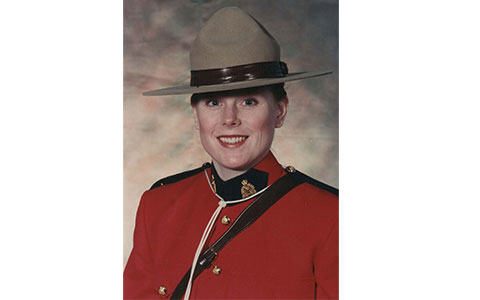
Growing up in Brockville, Ontario, White was extremely athletic, and envisioned a sports-related career. “I really hadn’t considered policing,” she admits. But after a friend made the suggestion, she found herself at 25 years of age at the RCMP’s training academy (Depot) in Regina, Saskatchewan.
“I don’t think I had any real idea of what I was getting myself into,” says White. “To arrive and be in a dorm with 31 other women was definitely an eye-opener for me as a girl with three brothers, but I adjusted quickly. I was there to learn, and I just focused on getting through the training.”
At Depot, she met her closest friend. “Depot can be demanding,” says retired RCMP Chief Superintendent Lorelei Rollings. “But Laurie was the perfect antidote to the rigours of training. Her approach was always: let's get the job done, let's do it well, and let's have as much fun as we can along the way.”
After Depot, White’s first posting found her in picturesque Kitimat, British Columbia in 1996. But after only two years as a police officer, everything came to an abrupt halt.
10-33 officer down
After telling her partner that she’d been shot, she found herself being quickly dragged to safety, and heard him say to the dispatchers, “10-33.”
A Medevac plane flew White to Vancouver, where eight hours of surgery followed. When she awoke, she was told that her right leg had been amputated five inches below the knee in order to save her life. “For a long time, I did not look at it. I felt that looking at it would make it real.”
Road to recovery
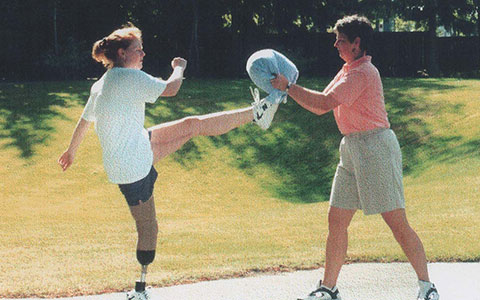
After a few weeks in hospital, White began months of intensive rehabilitation. “The wound healing was extremely challenging. Infections were problematic. So, there were many hurdles to overcome at the beginning.”
Those hurdles included learning to walk with a prosthetic leg, and grappling with the knowledge that her life was forever changed. “Everything was so overwhelming and the pain was excruciating. I became suicidal, contemplating ways I could find relief by escaping it all. I was truly angry I had survived when all I wanted was to slip away and disappear.”
White was determined to go back to work, which required requalifying at the RCMP PARE (Physical Ability Requirement Evaluation) test. The preparation was gruelling. “Honestly, it was a 24-7 job for me. I was going to physio for hours, working out at the gym, and practicing walking every chance I got.” She also had to redo her police driving test, see a psychologist, pass the computerized use of force simulation, and redo her firearm certification. “I needed to make sure that I could be ok with the sound of guns,” she says.
She passed the PARE, and 10 months after her shooting, White returned to full, unrestricted general duties – the first amputee in the RCMP to ever do so with a prosthetic leg. But while her colleagues in the small detachment in Kitimat were very supportive, she faced countless hurdles over the following years. As a permanently disabled employee with PTSD, she often wasn’t well accommodated, and navigating her disability benefits was overly complicated.
It’s a gap Laurie has spent years speaking out about. Today, partly because of the trailblazing paths of injured members like her, the RCMP has evolved to implement programs like the Support for Operational Stress Injury (SOSI) Program, available to all categories of RCMP employees, including veterans. In addition, the National Reintegration Program helps members process their reactions following critical incidents, including member-involved shootings. “Through peer support and guidance from members with lived experience, the program helps individuals reintegrate into the workplace, and prepare for a successful return to duty when appropriate,” says Kim Nocita, Director of RCMP Occupational Services.
Moving forward
White retired from the RCMP in 2020. Today, she is guardedly optimistic about the way physical and mental health is addressed, but she emphasizes that institutional talk needs to match institutional action.
“Increasing awareness is a good first step, but the organization actually has to live it,” White says. “The RCMP needs to do better to support us. We are the organization's most critical asset. Members run toward danger and make immense physical and psychological sacrifices—we deserve that support.”
It’s a message White has championed for almost three decades now. She’s been sharing her journey as a public speaker since 2000, inspiring audiences across Canada. She is also the author of her memoir, 10-33: An Officer Down Steps Back Up.
Her friend and former colleague couldn’t be prouder of the enduring legacy she is building. “What impresses me most is not simply that Laurie survived, but the way she continues to give of herself,” says Rollings. “She shares her experiences with vulnerability, wisdom, and generosity in order to help others.”
“When life gets difficult, you want Laurie in your corner. She was that person at Depot thirty years ago, and she is that person today.”